$7 · Instant download
Comment twenty-seven, as specific as comment three.
Ten sections that turn the call you have already made on a piece of work into rubric-anchored comment language in your own register — rubric stems, the stack-of-thirty workflow, the hard truth said well, the five-minute conference — and a section 10 that assembles the keepers into the file you open every grading night.
- Comment three is specific and useful. Comment twenty-seven says "good work, see me".
- The rubric says "developing" and the student has no idea what to do on Monday.
- You know what is wrong with the paper in four seconds and it takes six minutes to write it kindly.
- The hard feedback either lands too soft to register or too hard to hear.
- The stack is thirty deep and the quality curve is falling with your eyelids.
- The paper failing everything needs triage, not a list of everything wrong with it.
One-time purchase · 30-day refund, and you keep the files · Free updates
01 — What this kit does, and what it will not do
This kit drafts comment language. It never grades — no score, no verdict, no judgment about the student. You decide what the work is worth and the kit helps you say why in language a fifteen-year-old can act on. Work goes in as text you paste; names do not. AI drafts. You decide.
02 — What is inside
01
Your rubric, translated
Every criterion on your rubric turned into student-readable comment stems at each performance level — the sheet you keep open while you grade, and the raw material the later sections draw on. Nothing here picks a level; the stems wait until you have looked at the work.
02
Comments on this piece of work
Paste one de-identified piece, state your judgment in a phrase — clear claim, evidence thin, conclusion trails off — and get two or three comments in your voice that quote the student's actual sentences. Never a score.
03
The voice card
Ten minutes in September turns your own best past comments into a short six-rule card you paste at the top of any grading chat, so comment forty in April comes from the same person as comment one.
04
The stack of thirty
The volume workflow: one line of notes per paper — the number, your call, and the few words you want quoted back — so the papers stay on your desk and the notes do the traveling. The prompts stop at a thin note and ask you rather than invent a sentence.
05
When it's a mess
The paper where nothing is right: triage to the two problems that unlock the rest, tell the student in writing what you deliberately left alone, and offer the do-over inside the policy you already set. This section will not tell you whether a student used AI, and it says why.
06
Your feedback system
Section 10 lifts the comments that earned their keep out of chat windows and files them by the problem each one addresses, indexed to the assignments on your calendar — every stored comment keeping a blank where the student's quote used to be.
03 — You get
- 01 30 failure modes + repairs
- 02 30 fill-in prompts
- 03 30 follow-up chain steps
- 04 Printable quick reference
- 05 Plain-text companion
- 06 The manual: 83 pages, ten sections, from rubric stems to the file you open every grading night
- 07 A one-page START HERE map: which file is which, and the read order
04 — Look inside
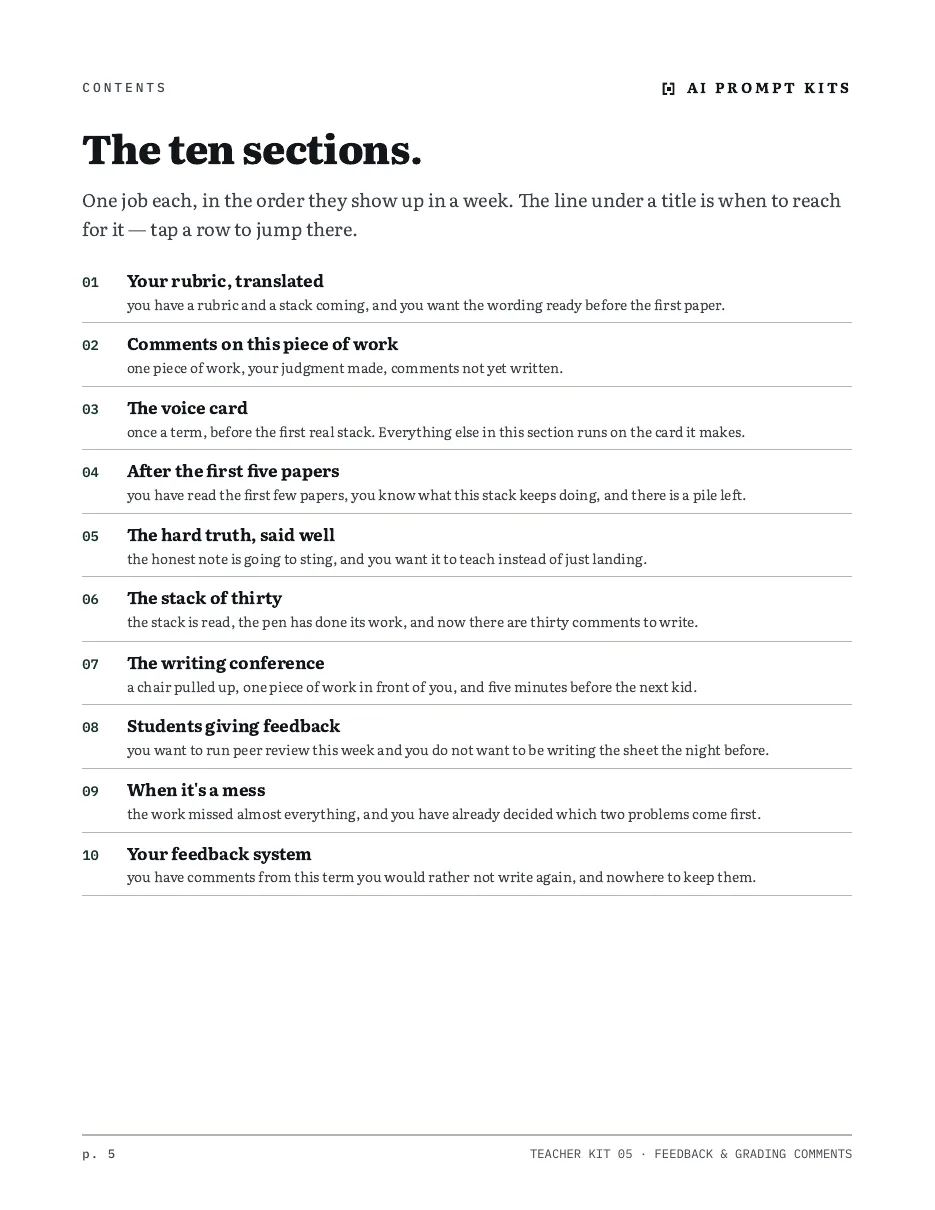
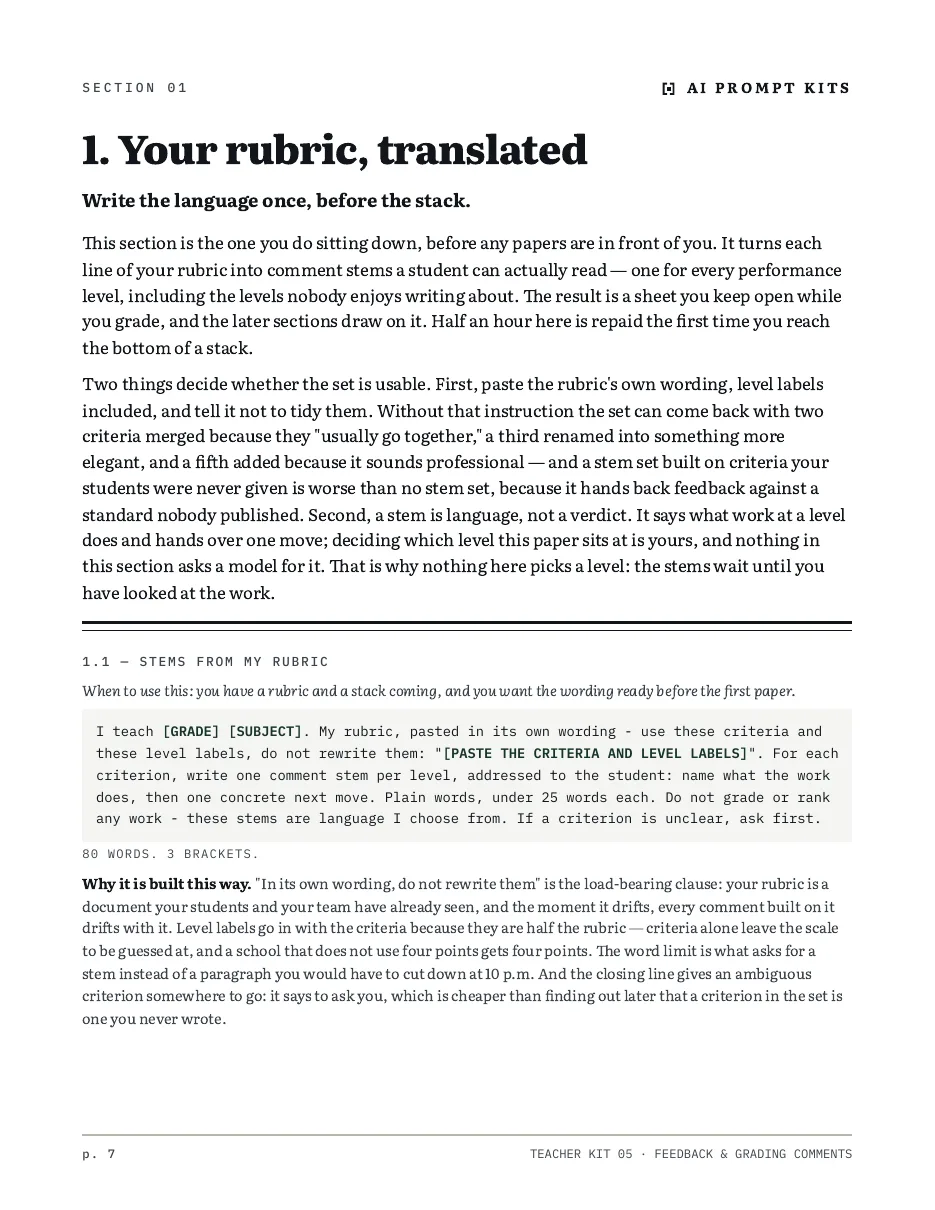
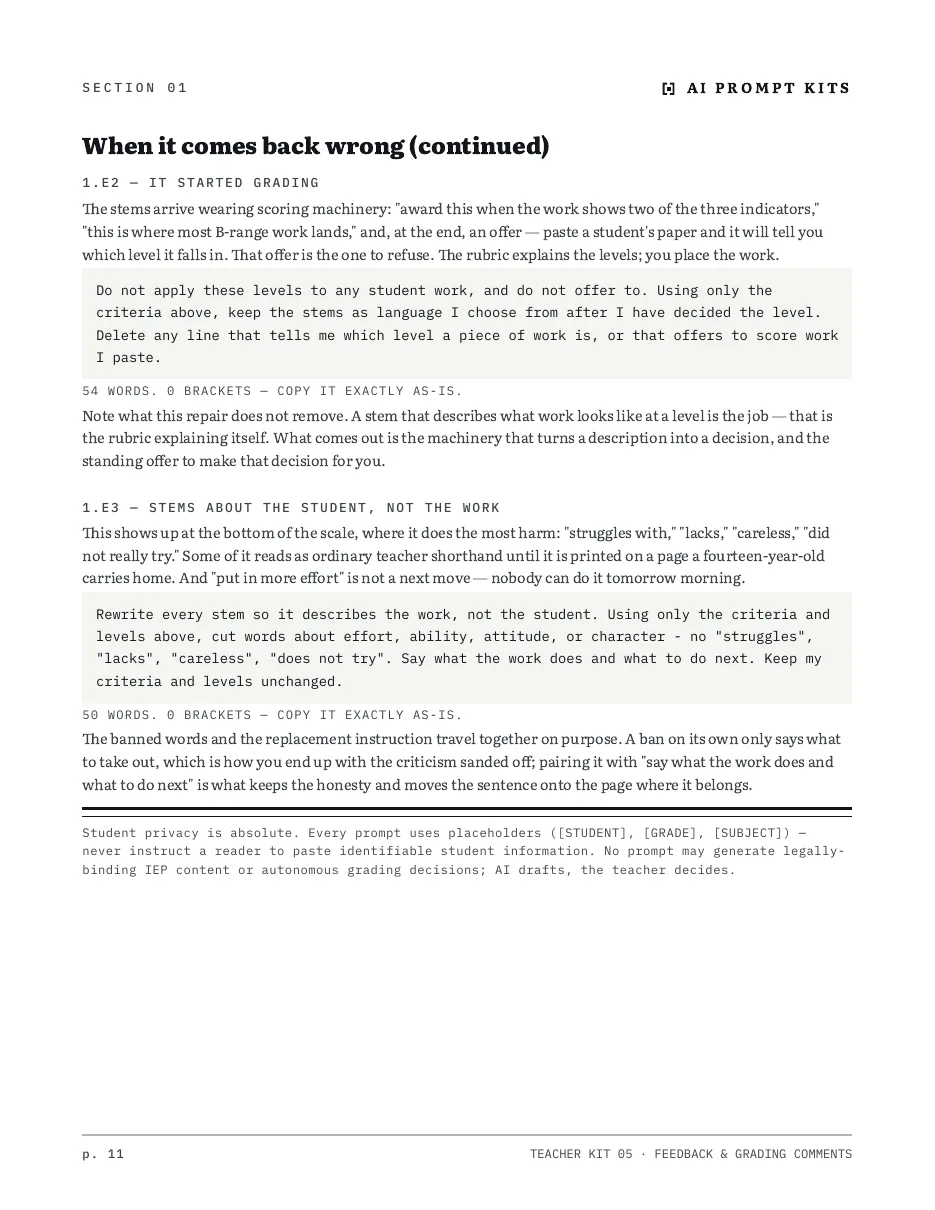
Three pages from the 83-page manual, exactly as they print.
Who makes these
I'm Zander Krause. I run three media businesses almost entirely on AI agents — that daily operating work is where these kits come from. What I am not claiming: that AI replaces your judgment, or that any prompt is magic. These are wordings tested until they stopped failing in the ways each manual lists. If a kit is not right for you, email support@aipromptkits.com within 30 days of buying and it is refunded to your original payment method — no form, no explanation, and you keep the files you downloaded. Questions before buying: support@aipromptkits.com — a real person reads it.
30-day refund, no explanation needed · The price is the price tomorrow too